
Climate Plan in action
Our Climate Plan is delivered through a range of initiatives that reduce emissions, support climate resilience and embed sustainability throughout the University. Explore the key areas where we are taking action and creating impact.
Delivering net zero
We are reducing emissions across our estate, travel, procurement and resource use through practical action and long-term investment.
 From improving energy efficiency and transitioning to cleaner energy sources to working with suppliers and partners, this principle focuses on turning our climate commitments into measurable progress.
Achieving sustainable travel
We are making it easier for staff, students and visitors to choose sustainable travel options and reduce the environmental impact of journeys to, from and around campus.

Through helping deliver the University's Sustainable Travel Plan, we are making it easier for staff, students and visitors to choose sustainable travel options and reduce the environmental impact of journeys to, from and around campus.
Our Climate Plan includes emissions reductions ambitions on travel. Electric vehicles now make up 35% of the University's vehicle fleet, with a further 7% comprising hybrid vehicles. All journeys undertaken on University business contribute to our carbon footprint. We encourage all staff to follow the travel hierarchy when making travel decisions and prioritise lower-carbon travel options where appropriate.
Working with partners across Leeds, we are promoting walking, wheeling, cycling, public transport and electric vehicle use to help create a healthier, better-connected and lower-carbon campus community. By understanding travel behaviours and investing in sustainable alternatives, we are reducing transport-related emissions while supporting healthier ways of living, studying and working.
Providing a sustainable curriculum
We are embedding sustainability across the student experience to equip graduates with the knowledge, skills and confidence to address environmental and societal challenges. Through our Leeds Sustainable Curriculum framework, we are embedding Education for Sustainable Development across teaching and learning, ensuring all students have opportunities to engage with sustainability as part of their studies, regardless of discipline.
 Students have opportunities to explore sustainability within their chosen subject while engaging with broader global issues such as climate change, social justice and sustainable development. Our approach connects learning with real-world challenges, enabling students to apply their knowledge through research, community engagement, interdisciplinary collaboration and practical projects, including opportunities through initiatives such as Leeds Living Lab.
Shaping institutional decision making
We are embedding sustainability into the way decisions are made across the University.
 By integrating sustainability considerations into existing governance and decision-making processes, we are ensuring that environmental and social impacts are considered alongside financial, operational and strategic priorities. This approach helps align everyday decisions with our long-term climate ambitions and creates lasting organisational change.
Supporting a net zero city
We are using our expertise, partnerships and institutional leadership to support climate action in Leeds and beyond.
 The Supporting a Net Zero City principle aims to build on our position as an anchor institution in the City of Leeds by connecting University expertise and research to our communities, neighbours and civic partners across the city and beyond.
Building on University research that pioneered the first climate commission in Leeds in 2017, the principle provides investment into both Leeds Climate Commission and the Yorkshire & Humber Climate Commission to grow their scope and ambition for place-based climate action.
Closer to home, the principle supports the expansion of the Sustainability Service's Living Lab and Positive Impact Partnership programmes to deliver greater impact for our communities and civic partners by developing creative solutions to real world challenges.
Enabling responsible investment
We are ensuring that our investment and banking activities support our values and long-term sustainability ambitions.
 Through responsible investment principles and ethical decision-making, we seek to balance financial performance with positive environmental and social outcomes.
Reorienting research and teaching
We are creating climate solutions on a local, national and international scale. This is through our global connections, world-leading research activity, and Leeds Living Lab.
 We are moving our research and teaching away from the fossil fuel sector unless it helps reduce greenhouse gas emissions or the transition to a low carbon future. We are collaborating with our colleagues to make sure this is done in a way that does not impact the quality of our research or teaching.
Reorienting research
To reorient its world-leading expertise in subsurface characterisation, resource exploration and geoengineering away from an oil and gas focus, the University rebranded Petroleum Leeds as Geosolutions Leeds in October 2020.
Since then, we have initiated new research projects focusing on geothermal energy, carbon capture and storage, hydrogen storage, nuclear waste, and critical minerals. Geosolutions Leeds has also led the set-up of Joint Industry Projects, which include a new project focused on offshore wind, with researchers helping to reduce risk and costs through improved siting of wind farms and turbines.
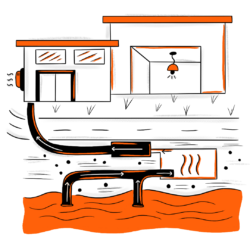
In early 2024, the University began exploring the potential to harness geothermal energy to heat and cool campus buildings. Before this project, the potential of ground-source heat beneath the campus and across Leeds was largely unknown. Drilling the boreholes has provided valuable insights, and we are working with Leeds City Council to see how this approach can be rolled out across the region.
Reorienting teaching
We have also reviewed our curriculum to ensure we’re training the next generation of geoscientists, engineers, and environmental and social scientists to accelerate the delivery of low-carbon solutions.
In 2023, we ended our MEng and BEng Petroleum Engineering undergraduate programmes and developed new modules. The new programmes benefit from the integration of new relationships developed as part of the Geothermal Campus project to bring real-time data and novel teaching methods and resources into the programme.