
Climate resourcefulness across 8 community climate hubs
Community climate action often begins with simple ideas: people coming together to make small changes in the places where they live. Over time, these efforts can grow into powerful networks of local resilience and ‘resourcefulness’.
This was the case with Climate Action Leeds, a five-year National Lottery Climate Action Fund project that created a network of local practitioners all working toward a nature friendly, net zero, socially just Leeds. The project supported the development of eight community climate hubs across neighbourhoods in Leeds and identified seven specialist community-led organisations to focus on key climate resilience themes such as food, housing, nature, and energy. Together, this network of organisations and the people within them created spaces and opportunities for people to learn new skills, strengthen local relationships, and develop practical responses to climate challenges in their communities.
As the project reached its final stages, the team partnered with the Positive Impact Partners (PIP) programme to reflect on what had been achieved, and what learning could inform the future of community climate action in Leeds.
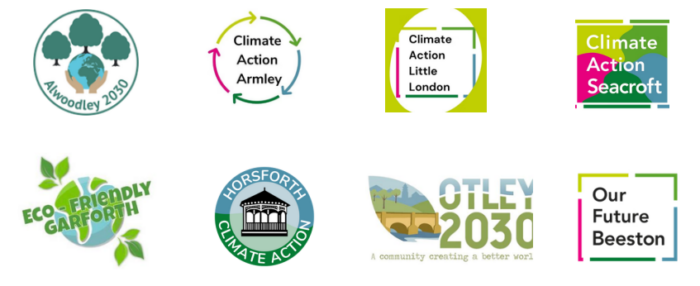
Logos of the 8 community climate hubs.
Project Overview
To capture these reflections, Dr Stella Darby (Lecturer in Geography) and community colleagues hosted a series of learning capture days with participants from each of the eight community climate hubs. During these sessions, people involved in the hubs took part in focus groups where they reflected on their experiences: what made their neighbourhoods special, what activities had emerged locally, the challenges they had faced, and what they hoped might come next.
These conversations generated rich insights into how community climate action had taken shape across Leeds, and the team wanted the analysis to reflect the collaborative ethos of the project. Dr Rebecca Brunk (Sustainability Service) joined Stella, Sue Hoey and Jennifer Walper Roberts (two community partners from Alwoodley2030, one of the community climate hubs) to co-analyse the focus group data and the Positive Impact Partners programme provided funding for both community partners to participate in four days of collaborative co-analysis of the learning capture data.
Sue Hoey described the process, saying “I enjoyed working together a lot. It was four days of hard work and good fun. We explored several different ways in which the data might be explored and then chose one together, which is not a lens that I would have had the insight or courage to analyse the data through had I been doing it alone.”
Through this process, the team began to see a broader concept emerging across the stories shared by the hubs: community resourcefulness for climate resilience. Across six different domains, this story of resourcefulness emerged: social connections, environmental improvements, emotional resilience, political influence, learning and adaptation, and stronger organisational structures. Together, these elements formed a framework for understanding how these communities had built the capacity to respond to climate challenges over the last five years.
Value of the Partnership
A key strength of the partnership was the opportunity it presented to bring together academic research expertise and community experience. For the community partners involved, participating in the analysis provided a deeper understanding of research methods while also allowing their own perspectives to shape how the data was interpreted. Sue reflected on the impact of the collaboration, sharing that, “having the support of Stella to carry out the research and both Stella and Becca to analyse the data was really helpful. It brought rigour to the coding of the data and taught me a lot about the process, what it entails, and how to be careful and yet not exhaustingly fastidious with it.”
Working together on the analysis created space for different perspectives to shape the findings. Community partners brought deep knowledge of the hubs and their histories, while the academic team contributed research methods and analytical tools. This combination helped build confidence and trust within the partnership. Working through the data together helped surface insights that may not have emerged otherwise, as Sue describes, “It brought a new perspective to a project which I am very familiar with and made the analysis process much more interesting and revealing than might otherwise have been the case... It was interesting and empowering to take a different perspective to the data and see what it had to offer.”
The collaboration also had impacts beyond the analysis itself. Working together throughout the project helped build confidence and familiarity across the partnership, changing how participants felt about engaging with academic research. Sue shares, “Personally, it has also made me feel less intimidated working with academics and has helped me to value the different perspectives and experiences that we all bring to pieces of work such as this one.”
Without the partnership’s methodological and material support, and the trust build between the partners, it would have been much harder to create the time and space needed for this kind of collaborative analysis.
Lessons Learned
Beyond producing the final report, the process highlighted the value of slowing down and taking the time to analyse data together. Co-analysis created opportunities for learning on all sides. Academic researchers were able to draw on the deep contextual knowledge of community partners, while community participants gained insight into qualitative research methods and the process of interpreting data. Perhaps most importantly, the collaborative approach helped surface ideas and perspectives that might otherwise have been missed.
As the final report from this project is published, it offers not only insights into the impact of Climate Action Leeds, but also a reminder that understanding community climate action is most powerful when communities themselves are part of the research process. Read the report here
We use the United Nations Sustainable Development Goals (SDGs) as a framework to guide our activity. This work is linked to the following SDGs:
- Goal 11: Sustainable Cities and Communities
- Goal 13: Climate Action
- Goal 17: Partnerships for the Goals
Find out more about our impact on the SDGs.