Creating Communities for Mainstreaming Sustainability

In this blog, Dr Pierre-Philippe Dechant, Lecturer at the School of Mathematics, explores innovative and community-led approaches to embedding sustainability in learning and teaching.
The University of Leeds’ vision of mainstreaming sustainability through its Curriculum Redefined and Sustainable Curriculum initiatives resonates deeply with my own values and educational philosophy. Whilst previously I cared deeply about sustainability, I believed it was separate from my subject and disciplinary identity (Maths/Physics) – a belief many at my School perhaps shared.
But being a Curriculum Redefined Transformative Educator offered me the opportunity to become a member of the Sustainable Curriculum team. This gave me license to think about embedding sustainability into teaching, learning, and assessment across Mathematics and Data Science, and across the University.
The students of course were well ahead of us and really wanted to see real-world applications of the course content that they learn, as well as being eager to put their skill set to good use in addressing global challenges. This curriculum innovation work is transforming the student experience, making it more holistic, globally connected, and future-focused.
LUNSHE: Building Communities for Change
One of the most transformative activities for me has been founding and co-leading LUNSHE - the Leeds University Network for Sustainability in Higher Education. We wanted to create a space for colleagues from across the university to learn from each other, from students, as well as from local and global partners.
This community of practice now connects over 200 colleagues across Service areas and Schools, providing an informal arena to share ideas, learn from each other, and explore together. A frequent monthly format is one hour over lunch (!) time with a couple of short talks in a topic area, followed by reflection for our own practice and discussion among the group. LUNSHE has delivered more than 30 events over 2.5 years and now includes some members from global partner institutions from 3 continents!
In November, we are holding a Yorkshire Universities special LUNSHE, connecting with HEI partners in the area. Complementing these monthly hybrid meetings we also have an active TIPS channel for asynchronous discussions and signposting. LUNSHE has been recognised as a case study in the UN SDG Accord Annual Report 2025 which further shows the influence an informal, supportive community can have, as well as in the Leeds #24 QS Sustainability ranking post.
LUNSHE is co-led between professional service staff (Clare Jackson, Lauren Eyles) and academics (Jonas Cromwell, Pierre Dechant), but is now largely driven by the community itself. It has facilitated the exchange of teaching materials, project descriptions, pedagogical articles, and other approaches to embedding sustainability in teaching.
Despite - or rather because of - its informal nature, LUNSHE has facilitated personal connections between colleagues that have led to more formal initiatives, networks, papers and grants.
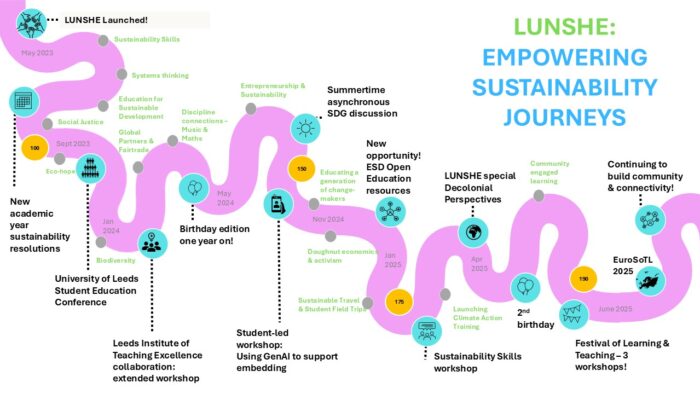
A timeline of key LUNSHE activities and milestones from launch in May 2023 to November 2025.
Library Sustainability Data Repository: Enabling Value-Led Learning
As programme director of the new BSc Data Science and as a member of the Sustainable Curriculum team, I proposed to find synergies between data and sustainability, and to make sustainability-related datasets available through the University Library.
Such a repository would be useful for students’ curricular activities (e.g. dissertations), extracurricular interests (perusal, curiosity) and skills development (e.g. statistics training modules). Materials could be accessible for a range of technical levels, from raw data to curated data visualisations. This was a matter very close to my heart (and my two hats!), so we are very proud to have just launched the prototype of a repository on the library webpages.
This resource empowers students to engage with real-world challenges and to define meaning for themselves, fostering authentic and value-led learning experiences.
Departmental Impact: Mathematics and Beyond
Having been given permission by the Sustainable Curriculum team to think about sustainability in Mathematics teaching, I was then able to give license to my colleagues at the School of Mathematics as School Sustainability Lead. As a School, we have increased the number of modules with explicit sustainability content from zero to twenty in two years. Student feedback highlights the positive impact:
“Focusing on sustainability for case studies is a brilliant idea… showing real-life scenarios that we can explore with what we’re learning. Including it in the curriculum more would be amazing.”
We have also linked our dissertation project descriptions to sustainability, and I have run a project on embedding sustainability in the mathematics curriculum with groups of 6 final year students for the last 3 years. This year, we are branching out into modules in Philosophy, Computer Science and Education, broadening the impact beyond the School.
Global Partnerships: Collaborative Online International Learning, International Strategy Fund, and Horizons Platform
In the same spirit of finding synergies between data and sustainability, Dr Julian Brooks from the School of Computer Science, others and I have run Collaborative Online International Learning workshops for 180 students from Leeds and our global partners Pretoria, Witwatersrand and SWJTU. The students were coming from computer science, data science, statistics and maths and were thinking of how they could apply their subject-based skills set in local sustainability challenges.
Funding from the International Strategy Fund (Driving sySTEMic change: connecting STEM education to sustainability and global collaboration) and Horizons Platform (DATA - From Extraction to Exchange: Decolonial Approaches to Technological Agency), allowed us to develop the strategic institutional partnerships and broaden out the research scope beyond disciplinary student education into more holistic and decolonial aspects as well as community engagement, looking at Makerspaces and hackspaces.
As a multi-institutional partnership, we have both run American Statistical Society Datafest hackathons collaboratively and also convened a working group at the global computer science education conference CompEd in October 2025. We also ran a global educator-facing conference, COIL-Ed Spring, in May 2025, exchanging experiences around experiential learning and COIL, as well as a design workshop to plan new COIL initiatives.
The next COIL-Ed Spring is due to run in Johannesburg in October 2026. As a result of these global activities, I have been invited to speak about approaches to departmental and institutional embedding of sustainability in Asia and Africa.
LITE Incubator Lead: Scaling Innovation
Where LUNSHE created a community to enable collaboration and discussion on teaching practice, the LITE Incubators seek to create communities for pedagogical research. My recent appointment as LITE Incubator Lead for Sustainability and Community Engagement provides a platform to amplify these efforts, covering the whole spectrum between teaching practice and pedagogical research, and making the natural connection between data, sustainability and community engagement. The Incubators will foster research projects by teams of staff (professional services and academic) that are co-created with students.
We have just appointed a Student Partner to the Incubator and look forward to working with them and other students to embed Student Voice in everything we do. The CENTRE and LUNSHE networks are great practice-focused communities with whom we can incubate pedagogical research projects, supported and underpinned by the LITE Fellowship Preparation Pathway.
We will have co-design workshops, seminars and journal clubs by the Incubator, collaborations with other Incubator themes, and general LITE support with research design, ethics, evaluation and pedagogical underpinnings as well as help with bridging any gaps that participants have identified as needing developmental support with.
Personal Reflection
"Embedding sustainability has transformed my teaching from content delivery to co-creating meaningfully connected real-world examples with students whilst creating enabling spaces for colleagues."
Whilst maths and data science broadly underpin all SDGs through modelling, statistical analysis, machine learning and data visualisation, we have developed more specific, nuanced real-world examples, often inspired by colleagues from different disciplines.
Just this week, I am using the idea of SDG progress report cards I got from a colleague in my own teaching. Students pick an example SDG that is meaningful to them and think through the complexities of dependencies and feedback loops between them using systems thinking, broadening their understanding across the three pillars of environment, society and economy.
Ultimately, this work benefits not only students but also my own development as an educator committed to shaping a curriculum that reflects our shared responsibility for a sustainable future. Though informal, incremental, collaborative and supportive, our work is meaningful and has ripple effects on a global scale.
About the Author
Dr Pierre-Philippe Dechant is a Curriculum Redefined Transformative Educator at the School of Mathematics, a Senior Fellow of the Higher Education Academy, a Fellow of the Institute of Mathematics and its Applications, and a Fellow of the Institute of Physics. At School level, Pierre leads on embedding sustainability by working with different module leaders as well as within the programme design and delivery of a new BSc Data Science that he is leading.
He also incorporates aspects of decolonisation and sustainability in the modules he teaches on - History of Mathematics, Data Science and Communication, Modelling for Big Data, and Graphs, Networks and Systems - and offered BSc dissertation and Laidlaw projects that focus on embedding sustainability in the mathematics curriculum. He is particularly interested in intersections between sustainability and data science and works in that space with.
We use the United Nations Sustainable Development Goals (SDGs) as a framework to guide our activity. Our work on the Sustainable Curriculum is linked to the following SDGs:
- Goal 4: Quality Education
Find out more about our impact on the SDGs.