
Everything is connected. Are we teaching students to see it?
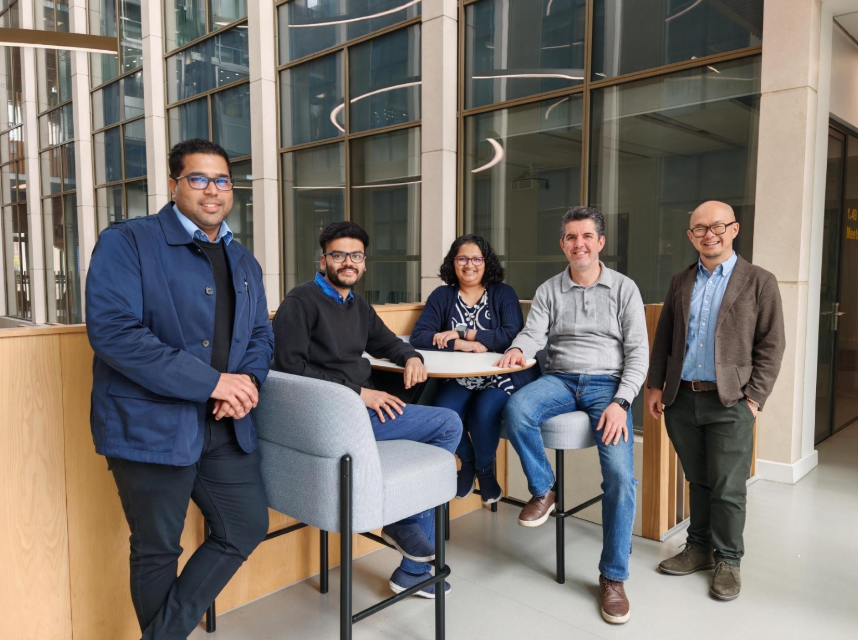
In this article, five members of the Engineering Education Group, drawn from Chemical and Process Engineering, Civil Engineering, and Electronic & Electrical Engineering, share their reflections on systems thinking as both a teaching challenge and a professional imperative. Their reflections are informed by the Student Sustainability Conference 2026, where student voices revealed the gap between how we teach systems thinking and how students actually experience it.
What does it mean to think in systems? Ask five engineers, and you will get five different answers. Ask students, and the picture becomes even more interesting. At the Student Sustainability Conference 2026, we did exactly that, and what emerged challenged us as educators more than we had expected.
As a group spanning Chemical and Process Engineering, Civil Engineering, and Electronic & Electrical Engineering, we share a commitment to preparing students for a world in which sustainability challenges cannot be solved by any single discipline, calculation, or set of assumptions. But do our curricula reflect that commitment? The conference prompted us to reflect honestly and listen.
What students actually mean by systems thinking
Before the conference, we were not entirely sure how our students understood systems thinking, whether they had internalised its core ideas, including feedback loops, interdependencies, unintended consequences, and the messy complexity that emerges when you look at a problem as a whole. The survey responses confirmed that uncertainty, at least at first.
"Systems thinking means looking at the challenges being solved." - Student voice, Sustainability Conference 2026.
At first glance, that answer might appear superficial. However, it reveals a truth: students naturally focus on problems. They turn to systems thinking not as an abstract concept but as a practical approach for addressing particular issues. This is not naive; it is pragmatic. And it is a lesson we can take from them as educators.
“In civil engineering, we design infrastructure that will shape communities for decades. A road is never just a road. It determines who has access to employment, how carbon emissions flow through a city, which neighbourhoods are divided, and which are connected. Yet we rarely frame it that way to our students. Seeing students reach for problem-solving as their entry point into systems thinking reminded me that perhaps we should start with the problem, too, and let the system reveal itself from there.” - Dr Ashani Ranathunga, Civil Engineering.

Dr Ashani Ranathunga, Lecturer, Programme Lead (BEng/MEng Civil, Civil & Environmental and Civil & Structural Engineering), School Academic Lead for Inclusive Pedagogies, School of Civil Engineering.
What emerged from the richer responses was even more encouraging. One student described systems thinking as considering "social, environmental and economic perspectives" together, while another spoke of looking at sustainability "holistically rather than individually." These are students who have begun to see the joins, and that matters, regardless of which discipline they come from.
Interdisciplinary thinking is not a soft skill. It is a sustainability requirement
Perhaps the most striking response we received came from a student who described systems thinking as "an interdisciplinary approach to understand a correct problem with a correct question." That phrase, a correct problem with a correct question, is worth sitting with. It suggests that before you can engineer a solution, you have to earn the right to the problem. You have to understand it well enough to ask the right question. And that, almost always, requires other disciplines.
"Thinking about all stakeholders when solving sustainability challenges, how can everyone play a part and consider any limitations and risks at the same time." - Student voice, Sustainability Conference 2026.
What students are describing, the need to hold multiple perspectives simultaneously, to weigh risks and responsibilities across a whole system, is something colleagues across our disciplines encounter in their own practice daily. Yet the gap between experiencing this complexity professionally and finding ways to teach it explicitly remains a live challenge. The reflections below explore what that looks like from inside engineering education and what it is prompting us to do differently.
“Through previous projects, working across disciplines has shown how complexity can be transformed into shared understanding. It enables teams to work effectively by learning from one another’s perspectives, limits, and strengths.” - Dr Ben Chong, Electronic & Electrical Engineering.
Dr Benjamin Chong, Associate Professor, Academic Lead for Reflective Practice, Level 1 tutor, School of Electronic & Electrical Engineering.
“Developing systems thinking is genuinely challenging, especially when working with large-scale, multidisciplinary engineering systems. I’ve seen students panic when I first introduce this kind of project. However, with the right support, they begin to learn and grow. Over time, they really appreciate how this way of thinking helps them understand complex systems - and it also builds their self-confidence for their future professional lives.” - Dr Mohsen Besharat, School of Civil Engineering.

Dr Mohsen Besharat, Associate Professor, Deputy Director of Student Education and Assessment Lead, School of Civil Engineering.
From technical solutions to systemic change
If there was one theme that united the student responses across different backgrounds and levels of confidence in sustainability concepts, it was an intuitive grasp that good solutions require good relationships. Students who were not studying engineering still understood that technical expertise would be central to addressing sustainability challenges. What they were less sure of was how that collaboration would actually work.
"I would have an honest discussion and tell them my perspective as a business student, being more open-minded to bridge diverse communication gaps." - Student voice, Sustainability Conference 2026.
Honesty is something we rarely model explicitly. Technical education tends to present solutions as correct or incorrect, efficient or inefficient. But in the messy reality of sustainability challenges, a technically correct answer embedded in the wrong social context is simply wrong. Teaching students to navigate the challenge of being technically rigorous and humanly humble at the same time is the frontier we are all working towards, whatever our discipline.
“Thinking about engineering as improving society reminds us that technically correct solutions are not enough. We must be honest about assumptions, uncertainties, trade-offs, and consequences, because that is where engineering in service of the Sustainable Development Goals becomes real.” - Dr Wesley Doorsamy, School of Electronic & Electrical Engineering.

Dr Wesley Doorsamy, Associate Professor, Deputy Director of Student Education for Curriculum, School of Electronic & Electrical Engineering.
“Chemical engineering design, which conventionally requires the application of core technical skills, has increasingly started to centralise sustainability considerations. However, there is still considerable scope for improvement as these considerations are not holistic. While environmental sustainability receives considerable traction, socio-economic considerations are not as prominent. Yet for systemic change and implementing solutions that are globally acceptable and scalable, such holistic or systems thinking is vital. ” - Dr Manoj Ravi, School of Chemical and Process Engineering.

Dr Manoj Ravi, Lecturer & Programme Lead (BEng/MEng Chemical Engineering), School of Chemical and Process Engineering.
The Student Sustainability Conference 2026 did not give us a blueprint. It gave us something more useful: a set of questions we had not considered, surfaced through the words of students who are still forming their understanding of what it means to work across disciplines, across sectors, and across the boundary between technical knowledge and human experience.
As a group, we leave the conference committed to three things: embedding more genuine interdisciplinary contact in our modules, making the social and environmental dimensions of technical challenges more explicit rather than treating them as someone else's concern, and developing and rewarding systems thinking while creating more spaces for students to practise open, honest cross-disciplinary dialogue that systems thinking ultimately demands.
Everything is connected. The question is whether we are teaching students, in every discipline, at every level, to see it.
The Engineering Education Group brings together educators in Engineering who are committed to advancing excellence in teaching and learning. Through collaboration and shared expertise, the group fosters innovative approaches that bridge theory and practice, equipping students with the skills, creativity, and critical thinking to address complex global challenges. By promoting inclusive, research-informed education, the group strives to shape future engineers who are not only technically proficient but also socially responsible and forward-thinking.
Further reading
The Lemelson Foundation (2026). Engineering for One Planet Framework: Vetted Teaching Activities for a Thriving Future in a Changing Climate. Edited by Cynthia Anderson and Cindy Cooper. Portland, Oregon. Available at: https://engineeringforoneplanet.org/wp-content/uploads/2026/02/EOP-Framework-Climate-Education-Teaching-Guide.pdf
Engineering Professors Council (2025) Complex Systems Toolkit. Available at: https://epc.ac.uk/resources/toolkit/complex-systems-toolkit/
We use the United Nations Sustainable Development Goals (SDGs) as a framework to guide our activity. This work is linked to the following SDGs:
- Goal 4: Quality Education
- Goal 6: Clean Water and Sanitation
- Goal 7: Affordable and Clean Energy
- Goal 9: Industry, Innovation and Infrastructure
- Goal 11: Sustainable Cities and Communities
- Goal 17: Partnership for the Goals
Find out more about our impact on the SDGs