
Let’s go round again! Another year of circularity at the Repair Café
Student Sustainability Architect Leoni Wilkins (BA Sustainable Fashion) reflects on her experience promoting student engagement with the campus Repair Café in 2025-26.
The Repair Café was first launched in 2023 with the aim to create an environment that encourages repair and helps foster valuable skills whilst reducing waste and contributing to a circular economy. Monthly sessions are held where students and members of the community can bring their damaged items ranging from rice cookers to jumpers. Volunteers are on hand with repair skills in electrical, mechanical and textile repair to help guide you through a fix.
Since opening, there has been a total of 643 hours volunteered, 358 participants, 586kg of waste prevented and an estimation of 8177kg CO₂ emissions prevented (the equivalent of growing 136 tree seedlings for 10 years)! The Repair Café, which takes place in the Library Makerspace in Edward Boyle, has been firmly cemented as an influential sustainability initiative on campus. Through the dedication of volunteers and support from staff it has creating an environment where students can share their skills and collaborate through repair.

What happened in the Repair Café last year?
Over the past 12 months, the Repair Café has built on its success. In addition to the regular monthly events, three sewing skills workshops were held. Participants had the opportunity to make a cushion cover while learning foundational sewing machine skills. This was in collaboration with the Silsden Repair Café, led by one of their textile volunteers, Louise.
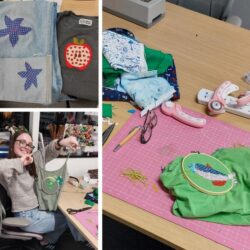
As part of my work as a Student Sustainability Architect promoting student engagement with the Repair Café, I delivered two successful upcycling workshops. The aim of these was to increase student awareness of the Repair Café as well as encouraging circular fashion, giving students accessible tools and ideas on how to extend the useful lifetime of old or damaged garments.
The workshops provided students the opportunity to learn more about repair and develop useful sewing skills and introduced new users to the Makerspace. The importance of repair is critical for a sustainable circular economy, with the disposal of textiles being a particularly prevalent issue. Prolonging the use of textiles is fundamental to reducing the environmental impacts of garments, avoiding the necessity of producing new fibres and associated emissions (United Nations Environment Programme, 2023).
To reflect, the Repair Café has had another successful year by building sustainable skills and establishing a space for student collaboration. The Repair Café provides an important opportunity to students both as volunteers to help build skills and create connections, as well as to participants to learn new repair skills and engage with circularity. The project’s success has been further recognised by being selected as a finalist at the UK and Ireland Green Gown Awards 2026 in the Student Engagement category.

Want to know more?
- See our events listings for upcoming Repair Café events.
- Anyone with basic to advanced skills in electricals, engineering, textiles or general repair can help volunteer!
- If you are interested or have any questions about the Repair Café please contact Chris Bowie.
We use the United Nations Sustainable Development Goals (SDGs) as a framework to guide our activity. Our work in the Repair Café is linked to the following SDGs:
- SDG 11: Sustainable Cities and Communities
- SDG 12: Responsible Consumption and Production
- SDG13: Climate Action


Find out more about our impact on the SDGs.