Our World: Sustainability education in the arts and humanities
In this blog, Ariana Phillips-Hutton reflects on embedding sustainability in teaching policy and practice, within discipline and interdisciplinary at the University, and intercultural collaborations.
As a member of the Sustainable Curriculum project team and a Curriculum Redefined Transformative Educator, Ariana brings together scholarly content and materials around embedding sustainability into the curriculum that are discipline-focused, interdisciplinary and pedagogically relevant. She also works to accelerate the embedding of sustainability within programmes of study and student experience by engaging with different Schools and OD&PL to develop staff confidence.
I joined the University’s Sustainable Curriculum project from the School of Music in December 2023 with the goal of helping to create cross-Faculty initiatives for embedding sustainability in teaching policy and practice. I was especially interested in how we could encourage colleagues who were less familiar with sustainability to embed it within their teaching practice.
To support this, I have constructed an evidence base through synthesizing scholarship in education for sustainability, alongside translating materials into disciplinary languages and promoting best practice in the creative embedding of core sustainability skills across the curriculum. Being part of the Sustainable Curriculum team has connected me to a wide variety of colleagues around the University while ensuring that insights from the arts and humanities are brought into conversations around sustainability education.
The knowledge and skills I have gained through working on the Sustainable Curriculum have also influenced teaching practice in my own School, where I have promoted new module themes which engage students in subject-specific learning on sustainability, including Music and Global Challenges and Eco-musicology. I have also encouraged colleagues to think about how sustainability skills could be integrated across different fields within the study of music, with one result being a new capstone module which recruits students to work together to respond creatively to real-world challenges and to communicate to a range of different audiences.
My desire to support a wide range of colleagues in embedding sustainability has borne fruit in my work on professional development, which seeks to develop shared resources that support staff across the University. This began with workshops that linked inclusivity and sustainability. This not only supports the professional development of staff but also contributes directly to the University’s KPI 7C of incorporating the climate principles, including Sustainable Curriculum, into organisational processes
Beyond the University, I have supported initiatives around translating sustainability within the creative arts, whether through running sessions on the application of the Sustainable Development Goals to the music industry for the Osaka Global School, mentoring an early career researcher investigating the intersection of climate justice and cultural heritage in Uganda, or through supervising a summer research project developing a sustainability curriculum for drama classes in Canadian secondary schools.
"My work on the Sustainable Curriculum has also fed into my broader research that considers how the creative arts can intersect with Sustainable Development Goals such as quality education, reduced inequalities, peace, justice and strong institutions, and partnerships to lead to a genuine decolonization of knowledge and a more equitable and just world."
When I joined the Sustainable Curriculum team, I was the only person on the project based in the Faculty of Arts and Humanities and I found that working in an interdisciplinary team was both stimulating and challenging. As part of this project, I’ve not only developed key resources that will help embed sustainability across the University and taken the lead in engaging with other members of my Faculty about the Sustainable Curriculum but I have also consistently brought the distinctive perspectives of the arts and humanities into larger cross-Faculty conversations around sustainability in education.
Working on the Sustainable Curriculum has revitalised aspects of my own teaching practice, provided a platform for raising the visibility and importance of sustainability for colleagues in my School and Faculty, and offered a framework for thinking about the intersection of key global challenges alongside students and collaborators from around the world, and I am excited to see where it goes next.
About the Author
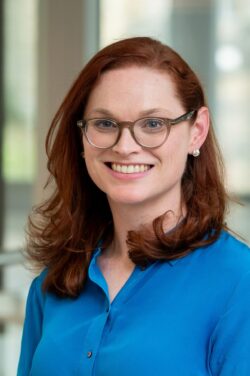
Ariana Phillips-Hutton is Lecturer in Global Critical and Cultural Study of Music and a Curriculum Redefined Transformative Educator. Her research ranges broadly across the philosophy, performance, and politics of contemporary musical traditions, with a particular focus on eco-musicology, musical ethics, and music’s relationship to violence and conflict transformation.
We use the United Nations Sustainable Development Goals (SDGs) as a framework to guide our activity. Our work on the Sustainable Curriculum is linked to the following SDGs:
- Goal 4: Quality Education
Find out more about our impact on the SDGs