January 2026 LUNSHE
January’s LUNSHE session led by Professor Anne Tallontire, Laura Smith, Emma Green and Mary Souter explored how Fair Trade, Education for Sustainable Development (ESD), and student engagement come together at the University of Leeds. The discussion highlighted years of collaborative work between staff and students, showing just how powerful student‑led sustainability initiatives can be.

Professor Anne Tallontire, PFHEA
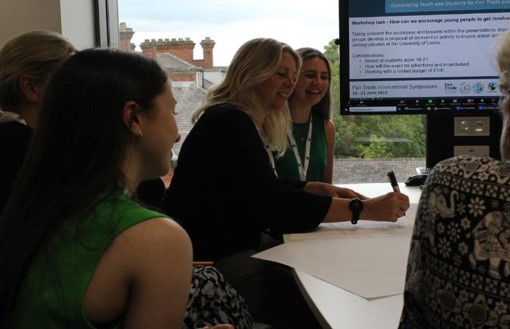
Anne reflected on the long-standing partnerships with students such as Emma Green, a former Student Sustainability Architect, and Mary Souter, whose undergraduate dissertation on Fair Trade and student perceptions continues to shape understanding of how students view and engage with ethical consumption. These student contributions, along with work from interns like Lucy and Joanna, have helped define Leeds’ approach to Fair Trade, including supporting the 2023 Fair Trade International Symposium hosted on campus.
A key theme was the importance of co‑creation. Fair Trade activity at Leeds has never been a top‑down exercise; instead, students are embedded as partners, researchers, practitioners, and critical voices. This approach not only strengthens the University’s sustainability work, but also supports deeper learning aligned with ESD principles: enabling students to practise systems thinking, question global trade structures, collaborate on real projects, and develop the confidence to contribute meaningfully to sustainability governance.
Thoughtful critiques were raised about the current Fair Trade campus accreditation process. While accreditation frameworks offer structure, they don’t always capture the richness of student involvement or the complexity of real engagement work happening within the University. The Fair Trade Steering Group continues to consider how to ensure student partnership is properly recognised and valued within these external standards.
Overall, the session demonstrated how Fair Trade at Leeds has become far more than a compliance exercise. It’s a living learning environment, one shaped by student insight, research, creativity, and critical reflection. It was great to hear about the importance of nurturing these partnerships and continuing to deepen the University’s approach to ethical and sustainable trade.
A brilliant reminder that when students and staff collaborate, Fair Trade becomes not just a label, but a shared journey of learning and action.
We use the United Nations Sustainable Development Goals (SDGs) as a framework to guide our activity. Our work on LUNSHE is linked to the following SDGs:
- Goal 1: No Poverty
- Goal 8: Decent Work and Economic Growth
- Goal 10: Reduced Inequalities
- Goal 12: Responsible Consumption and Production
Find out more about our impact on the SDGs